
Adventures in Prineville and Seal Rock
Sometimes the best astrophotography outings begin with almost no planning at all. This one started with a simple realization: the sky was clear, Newport was not going to give me the darkness I needed, and Prineville was calling. So on a whim, I loaded up the car, dumped what felt like my entire setup into a wagon, and headed for Sky Fire Ridge , my observatory above the Prineville Reservoir.
Sky Fire Ridge (Prineville)
There is a special kind of energy that comes from arriving at a dark site with ambitious plans and just enough daylight left to make them happen. I had four stations running simultaneously, which felt equal parts exhilarating and absurd. Every piece of gear had a purpose. One rig was collecting deep sky data, another was framing a wide field, another was dedicated to sky monitoring, and my camera was ready to capture the landscape and atmosphere around me. By the time darkness settled in, I was fully committed.

The evening rewarded the effort immediately. Just after sunset, the western sky gave me one of those beautiful alignments that feels almost staged: the Moon and Venus side by side, with M45, the Pleiades, above them, setting over Prineville with the silhouette of Mount Washington in the distance. It was the sort of scene that reminds me why I always try to keep a camera ready, even while the rest of the gear is still coming online.

As the sky darkened, the ridge began to reveal exactly why I had made the drive. One of the true tests of a dark site is whether the Milky Way shows its structure instead of just its shape. At Sky Fire Ridge, it did. The dark dust lanes were obvious. The fine, smoky tendrils splaying from the galactic core were visible. Even the delicate bridges of dust that seem to reach toward the Rho Ophiuchi complex were present. Those are details I simply do not see unless the conditions are genuinely pristine.

It was cold, too. The temperature dropped into the thirties, and I was camping with a small one-person tent, a sleeping bag, and a lot of electronics quietly blinking in the dark. That is part of the bargain sometimes. You put up with the cold, the setup, the cables, and the logistics because every once in a while the night gives something back that makes all of it worthwhile.
At around one in the morning, the ridge felt almost surreal. The LEDs from the gear glowed against the darkness, thin clouds stretched overhead in long pale streaks, and the stars still burned through above them. I always find something satisfying about that moment in a long imaging session, when everything is finally running and the night settles into its rhythm.

I came home and had an epiphany: instead of breaking down my equipment into various parts and categories, why not just keep my "field ready" set up in one place? I organized it into bins that I kept in the wagon, and was able to test the approach a few days later. I visited Seal Rock and used much of the same equipment with a very different result.
Seal Rock
That contrast is part of astrophotography too. One night everything comes together, and the next night you are reminded that all the gear in the world cannot negotiate with the atmosphere. At Seal Rock, I started with M81 because I wanted to capture the surrounding Integrated Flux Nebula (IFN), but thin cloud cover kept drifting through and I quickly ran into tracking issues while chasing the target. Since the IFN is so faint to begin with, I knew right away that clouds made the whole attempt unrealistic.
I pivoted to the Blue Horse Nebula, only to realize I was not actually framing the right location. After that, I fell back to Rho Ophiuchi, hoping I might still salvage something from the evening, but I never really got much traction there either. I managed to grab a few frames and caught a nice timelapse with my camera roll, but otherwise the night became a good example of how not every astrophotography outing pays off.

That does not make the trip a failure. If anything, it makes it honest. For example, I did get some good Milky Way shots.

If you're interested, you can watch the timelapse of my time at Seal Rock here:
Some outings are about bringing home a gallery of finished images. Others are about adapting, troubleshooting, learning, and accepting what the sky is willing to give you. Prineville was one of those magical nights where every station seemed to have a purpose and the sky rewarded the effort. Seal Rock was a reminder that patience matters just as much as preparation.
If you would like to see more images from the Prineville side of this adventure, I have posted the full Sky Fire Ridge gallery here: Sky Fire Ridge gallery.
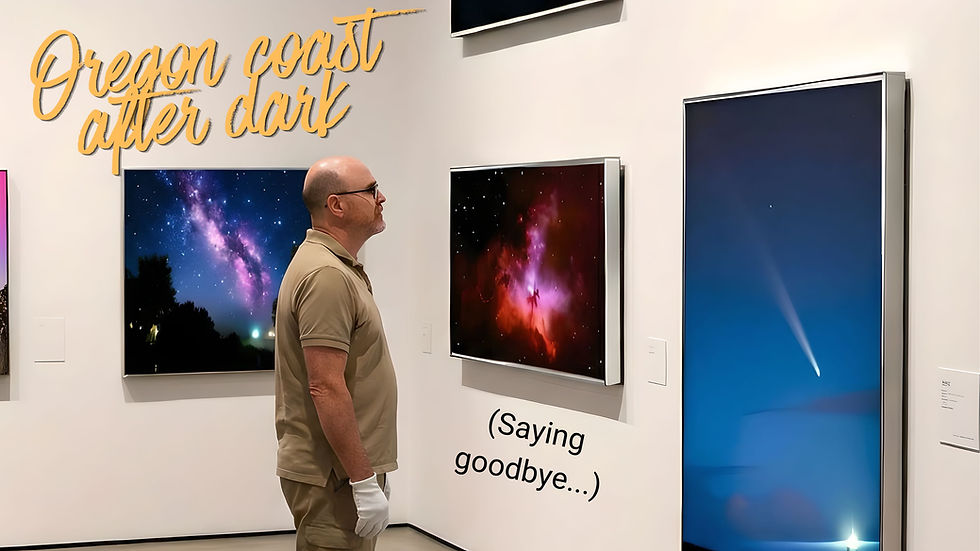
A quick note for anyone local: my exhibition, Oregon Coast After Dark, is concluding in just over a week on May 10. So if you haven't been yet, now is the time to try!


Comments